Separating challah is a beautiful mitzvah. This guide explains what it is, when it applies, how to do it and the blessing. It is educational: customs differ, so please ask your rabbi which custom you follow.
What it is
When we make dough from enough flour of the five grains (wheat, barley, rye, oats and spelt), we separate a small piece and give it a special status. In the time of the Temple it went to the kohen. Today it is burned. Many women also use this moment to pray.
When it applies
It depends on the amount of flour, and customs differ. These figures come from the published sources named below.
| Source or custom | Without a blessing | With a blessing |
|---|---|---|
| Star-K guidance | about 8 2/3 cups (about 1.2 kg) | about 12 1/4 cups (about 1.7 kg), or 5 lb (about 2.3 kg) per others |
| Kosher.com | 2.5 lb and up | 5 lb and up |
| Shulchan Aruch Harav (Chabad) | 1,250 g | 1,666 g |
| Old Ashkenazi custom | n/a | about 1,213 g |
| Chazon Ish | n/a | 2,250 g |
The big-batch recipe on our recipes page uses 2.5 kg of flour, which reaches every threshold above.
How to do it
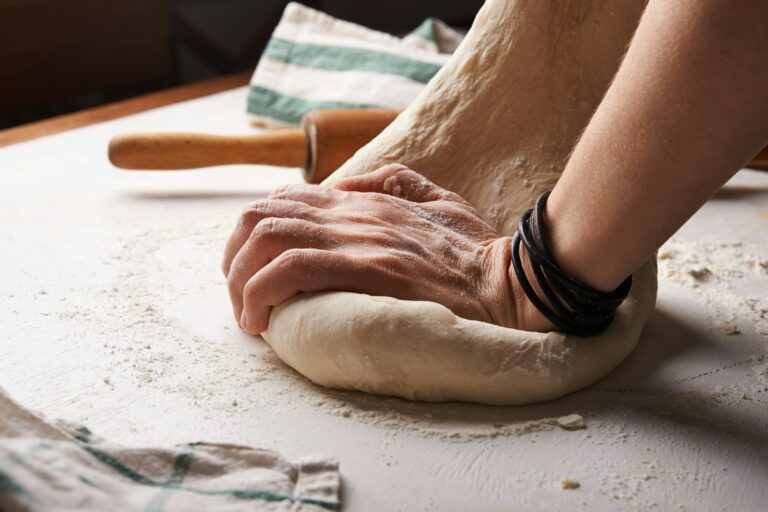
- Mix and knead the dough. You separate challah from the dough before shaping.
- Hold the dough and say the blessing below.
- Take a piece about the size of an olive and say, “Harei zeh challah” (this is challah).
- Wrap the piece and burn it safely, for example wrapped in foil in the oven or on a gas flame, or follow your local custom.
The blessing
ברוך אתה ה’ אלוקינו מלך העולם אשר קדשנו במצותיו וצונו להפריש חלה
Baruch atah Adonai, Eloheinu melech ha’olam, asher kidshanu b’mitzvotav v’tzivanu l’hafrish challah.
Blessed are You, Lord our God, King of the universe, who has sanctified us with His commandments and commanded us to separate challah.
A moment to pray
Many women take this time to pray for someone they love, saying the person’s name and their mother’s name. If you are baking for a name, say it quietly, in whatever words feel right. The custom of baking for a specific person is popular, though classic sources do not clearly cite it, so ask your rabbi if you want to know more.
Sources: Star-K, Kosher.com and Shulchan Aruch Harav (shulchanaruchharav.com) published guidance on hafrashat challah.